
Agent backends
Choosing a backend
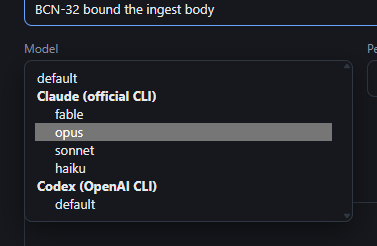
Ropenode drives two agent CLIs. You choose one when you create a session, from the same picker as the model.
| Claude Code | Codex | |
|---|---|---|
| Binary | claude |
codex |
| Sign-in | claude on first run |
codex login |
| Credential lives in | the CLI's own store | ~/.codex/auth.json |
| Models | fable, opus, sonnet, haiku | whatever ~/.codex/config.toml says |
| Edit policy, diff review, undo, Log | yes | no — see below |
| MCP servers from Ropenode | yes | no — Codex reads its own config |
The one rule both obey
Every session is driven by a CLI that owns its own authentication — the app never holds a model credential.
There is no code path that could store your key, because nothing in Ropenode talks to a model API.
Picking a model
For Claude, pick a model and Ropenode passes it to the CLI.
For Codex, Ropenode deliberately passes no --model flag at all, deferring to your
~/.codex/config.toml — your config is more likely to be right than our guess.
If a model does not belong to the session's agent, Ropenode leaves the choice to the CLI and tells you.
Using both in one project
The agent is fixed when a session is created, so to hand the same work to the other agent, start a new session in the same project. A project can hold both kinds side by side.
Which should you use?
Whichever you already pay for. If you have both, the practical difference today is supervision coverage — read the next page before deciding.
Last updated Oct 11, 2026